
Mapping Regional Scent Preferences: A Scope Checklist for a Pharmacy Range
Regional scent preferences are real, and they are also the most over-read input in a fragrance brief. What differs between markets is usually less about a national taste in smells and more about climate, occasion, price tier and the shelf the product sits on. For a pharmacy own-label range the shelf is the strongest signal of all. A scope that starts with the shopper mission rather than with a map of the world will give you a usable brief in weeks instead of a stack of contradictory trend notes.
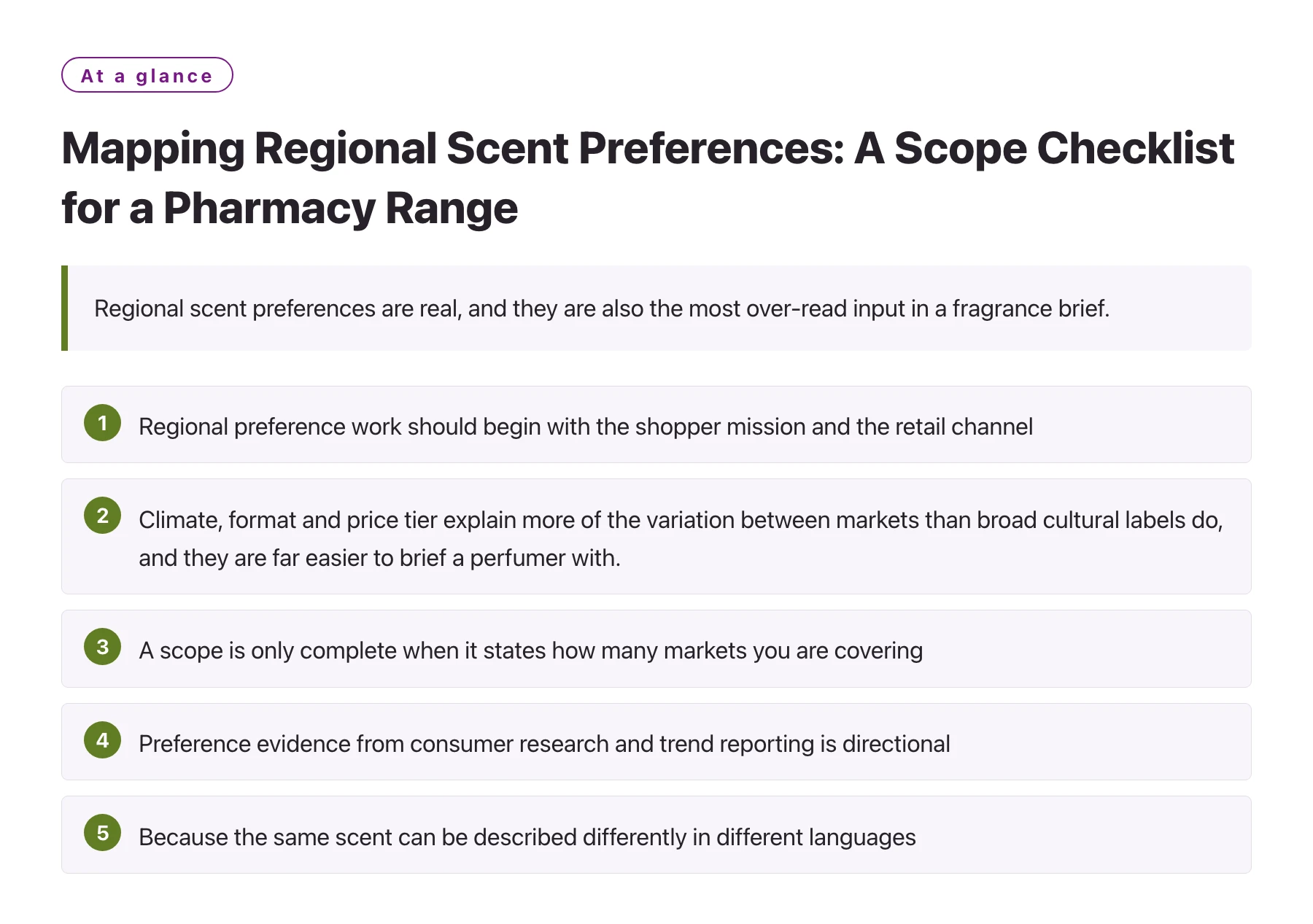
Key takeawaysRegional preference work should begin with the shopper mission and the retail channel, because a pharmacy purchase is driven by a different occasion than a department-store one. · Climate, format and price tier explain more of the variation between markets than broad cultural labels do, and they are far easier to brief a perfumer with. · A scope is only complete when it states how many markets you are covering, how many scent directions you will test in each, and who decides when testing stops. · Preference evidence from consumer research and trend reporting is directional, so it should shape hypotheses rather than settle a formula. · Because the same scent can be described differently in different languages, the scope should fix a shared vocabulary before sample rounds begin.
Most disappointing regional projects do not fail because the factory ignored the market. They fail because the brief asked for a market and the factory delivered a national stereotype: something described as fresh for one country, warm for another, without anyone agreeing what those words would mean on a blotter. Product developers then receive samples that are technically responsive and commercially unusable.
This checklist is written for the person assembling the brief, usually a product developer or brand manager inside a pharmacy or drugstore group. It sets out what the scope has to contain, how to keep the evidence honest, and where to stop researching and start smelling.
Start with the shelf, not the map
A pharmacy own-label fragrance is bought in a specific frame of mind. The shopper is already in the store for a health or personal care reason, the purchase is often unplanned and of modest value, and the product usually has to explain itself without a tester and without a sales assistant dedicated to fragrance. That context shapes the scent far more than any national preference does: it favours clean, immediately legible accords, formats that can be tried discreetly, and packaging that reads quickly at shelf height.
It also means the range is rarely one hero product. Pharmacy own-label lines tend to be small families: a couple of directions across hand, body or home formats, priced to sit beside the retailer's other own-brand categories. The scope should say which formats and price tiers sit inside the family, because dosage and material choice follow directly from that decision.
Before briefing anyone, it is worth studying how established manufacturers present their own categories and markets. A supplier's public pages show which formats and channels it habitually serves, which is a fast way to see whether your scope is even in its range; the Xuelei official site is one example of a manufacturer describing its own development and production offer alongside its home and personal care categories.
The eight items a regional scope has to contain
A scope does not have to be long, but a brief that leaves any of these eight open will produce a sample round that answers the wrong question. Write one short paragraph for each, even if the answer is 'we will decide later' — a stated open question is manageable; an unstated one is not.
1. Markets and climates
List the markets you are actually launching in, not the ones you hope to enter, and note the climate each product will live in. Heat and humidity change how a fragrance reads on skin and how a formula behaves in storage, so a range designed for a temperate market and shipped to a hot one will be judged on performance it was never built for.
2. Shopper mission and occasion
State what the shopper is doing when they buy and when they will wear the product. A hand cream bought as a small self-treat and a body mist bought for a gym bag are different products, and the scent brief should say so. This is the item most often skipped and most often responsible for a scent that is liked in a meeting and unsold on a shelf.
3. Formats and price tier
Fix the formats inside the first order, the pack sizes and the retail price band. Price tier constrains materials more than it constrains style, so the perfumer needs it before the direction, not after the costings.
4. Cultural note associations
Note which familiar materials carry meaning in each market, in both directions. Some notes read as nostalgic in one place and dated in another, and a good perfumer will work with that if you supply it. It is tempting to compress this into national adjectives; resist that and write about occasions, memories and the materials each market already buys.
Where a market has a strong indigenous perfumery tradition, that is a rich and specific source of directions rather than a generic theme. Ingredient stories drawn from a region's own materials give a perfumer concrete raw materials to work with, which is a very different brief from a mood board eastern fragrance notes explained.
5. Regulatory and labelling differences
Different markets set different limits, require different label content and treat claims differently. These differences belong in the scope because they change the formula, not just the paperwork, and discovering them late means reworking a scent that has already been approved.
6. Panel composition and how you will smell
Say who will test the samples, how many people, and how. A panel of six colleagues in one office is not a regional preference study; it is a directional check, and it should be labelled as one. If you want more than that, commission the research properly rather than multiplying informal tastings.
7. Decision rule and stopping point
Write down how many directions you will test, how many rounds you will run, and what has to be true for a sample to be approved. Without a stopping rule, sample rounds expand until someone senior loses patience, which is the most expensive version of a decision.
8. Refresh cadence
Decide how often the range will be reviewed and what evidence would trigger a change. Preferences move with demographics, retail assortment and fashion, and a scope that assumes a fixed answer will be quietly out of date within a couple of seasons.
Keeping the evidence honest
Consumer research and trend reporting about scent are useful for forming hypotheses and useless as proof of what your shoppers will buy. Broad trend work describes directions, moods and categories, and its value is in helping you decide what to test — not in settling the outcome [1]. The same applies to consumer-facing fragrance education, which explains how people choose and describe scent far better than it predicts a preference for your particular bottle [2].
The practical discipline is to separate three things in the scope: what you know about your own shoppers and stores, what published research suggests, and what you intend to test. Mixing them produces a brief that reads well and cannot be argued with, which is the opposite of useful when a perfumer asks a specific question.
A shared vocabulary is the cheapest quality improvement available. Agree a short list of descriptive terms with examples, and use the same words with every supplier. Fragrance language is imprecise across languages and even across departments, and most sample-round disagreements turn out to be disagreements about words rather than about smells.
Finally, remember that the factory brings its own evidence. A manufacturer that develops for many markets has seen which directions survive in which channels, and it can tell you where a request is likely to need a second round. That experience is worth asking for explicitly, and it is one reason to choose a custom fragrance development partner that has worked across export markets rather than one that only fills locally.
Cap the research. Give the preference work a deadline and a budget, then write the brief from what you have. A pharmacy range launched with a good-enough regional scope will teach you more in one season of sales data than another quarter of desk research, and the sales data is the only preference evidence that reflects your own stores.
Sources
- Mintel Press Centre —— Mintel's press releases on consumer and beauty market research, including fragrance and personal care trend reporting.
- The Fragrance Foundation —— A non-profit organisation for the fragrance industry, running perfumery education programmes and industry recognition.
Frequently asked questions
How many regional markets should a first pharmacy range cover?
Usually one to three. Beyond that the scope fragments, the sample budget is spread thin and the range loses the coherence that own-label pharmacy lines depend on.
Can one scent work across several regions?
Yes, and it often does. What travels is usually a clear, easily described direction in a familiar format. What does not travel is a heavily loaded scent that depends on local references to be understood.
Do we need consumer research before the first sample round?
No. A written scope grounded in your own shopper data is enough to start development. Research is most useful between rounds, when it can help choose between directions you have already smelled.
Who should sit on the internal panel?
A small group that includes someone close to the store, someone who owns the commercial numbers and someone who can say when a scent is not wearable. Add a person from outside the category to catch internal tunnel vision.
What is the biggest scope mistake in a pharmacy project?
Leaving the format and price tier open while writing at length about scent character. Those two decisions filter the material palette more than any descriptive language does.
Your week-by-week guide, free in your inbox
Join 1.1 million moms receiving our pediatrician-reviewed pregnancy and baby tracker.
Get My Free Week-by-Week Guide