
OEM or ODM Jewelry Manufacturing: Which Model Fits Your Brand
The question is not which model is better, it is who owns the drawing. Under OEM you bring the design and the workshop reproduces it; under ODM you bring a direction and the workshop develops the piece with you. The published minimums are 100 pieces in artisan brass, 100+ pcs in stainless steel and 50 pieces in 925 silver, counted per design.
Key takeaways
- OEM means you design and the factory produces; ODM means the concept is co-created with you, and both sit on one OEM/ODM process sheet.
- The six-step route, the CAD stage inside 48 hours and the 25–30 day sample window are identical on either path.
- Minimums stay at 50 / 100 / 100+ pieces per design no matter who drew the piece.
- Moulds, CAD files and the finished collection remain exclusive to your label under a 100% NDA.
What each model asks of you at the enquiry stage
An OEM brief is a set of files. You send a technical drawing, a 3D model, or a reference sample with correction notes, and the workshop answers one question: can this be made at this size, in this metal, at a cost that works? The design stays yours and the tooling is cut to your file.
An ODM brief is closer to a conversation. You send sketches, photographs or a mood board, and the design team helps decide what the piece is — its proportions, its stone layout, which of the six customisation groups it uses. What comes back is a collection developed for your label rather than a file handed over for execution.
Where the two routes are identical on the shop floor
Once a drawing exists, the difference disappears. Both models run inquiry, consultation and development, CAD and prototype, sample and approval, bulk production, then quality control and delivery. Both return 3D renderings inside 48 hours for dimensional sign-off. Both wait 25–30 days for the master physical sample and a further 3–4 weeks for the production run after approval.
So when a supplier claims ODM is slower, ask which stage is slower. The mould, the stone setting and the plating tank do not care who drew the piece. Working with an OEM jewelry manufacturer mainly deletes the concept debate, which is the one block that genuinely shortens when you arrive with a finished file.
The minimums do not change with the model
Order quantities follow the material, not the paperwork. Silver casts quickly and finishes easily, so the entry point is 50 pieces per design. Brass needs a plating stack before it reads as jewellery, so the entry point is 100. Stainless steel is machined rather than cast and usually finished with PVD vacuum plating, which is why it starts at 100+.
| Gate | Published figure | Why it sits there |
|---|---|---|
| 925 sterling silver, per design | 50 pcs | Lightest per-piece casting and finishing load |
| Artisan eco-brass, per design | 100 pcs | Plating cost is shared across the run |
| Stainless steel, per design | 100+ pcs | Machining and PVD set-up carry more cost |
| 3D CAD plus renderings | under 48 hours | Screen work, finished before metal moves |
| Master physical sample | 25–30 days | Wax printing, casting, setting, polishing, plating |
What the six customisation groups change about the brief
An ODM brief usually touches all six published option groups: the base metal, stones and accents, finishes and plating, the packaging set, logo and hallmarks and findings and chains. Some are settled once and never revisited — a hallmark is engraved as 316L on stainless, the S925 hallmark and 18KGP on gold-plated work according to the base metal, and it is laser engraved in the same pass as your own logo.
Others are decided per design, which is why an ODM collection tends to arrive as a family rather than a single piece. If one design is plated 18K gold and the next rhodium, those are two plating runs, and splitting them is a scheduling choice rather than a design statement.
Worked example: the two minimums side by side
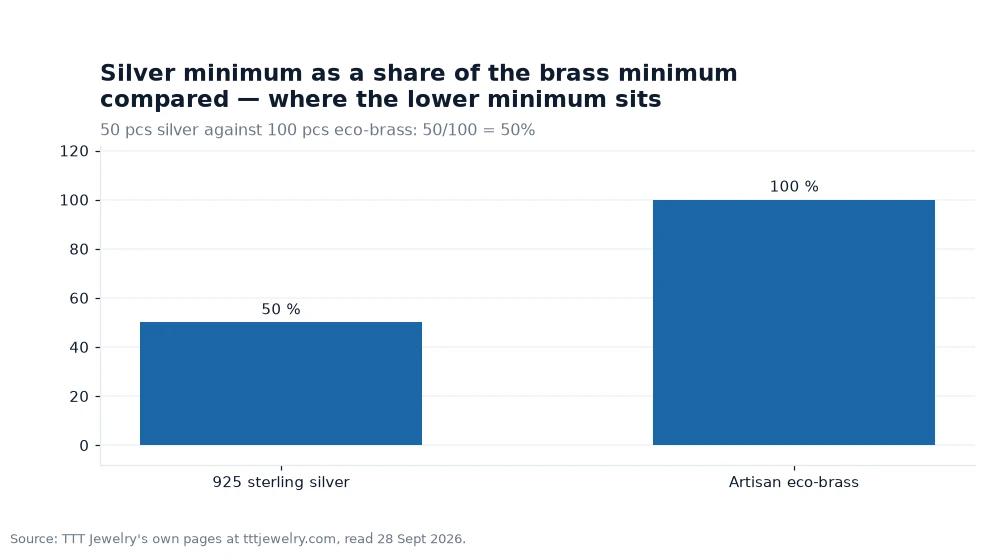
The published figures are 50 pieces per design for 925 sterling silver and 100 pieces per design for artisan eco-brass, so the silver minimum is exactly half: 50 ÷ 100 = 0.5, or 50%. Read the other way, the same shelf space and the same cash support two silver designs where it supports one brass design.
That ratio is my arithmetic — 50 and 100 are the published numbers. It matters most when a label launches several shapes at once. At 50 pieces, six silver designs total 300 pieces; the same 300 pieces spread across eco-brass covers three designs. Silver buys range, brass buys a lower cost per plated piece.
How the shared service layer behaves on either route
Both models inherit the same supporting layer, which is easy to overlook because it does not appear on a cost sheet: one dedicated project manager for the account, a 24-hour response to questions, and 100% NDA coverage before any file changes hands. The project manager is the person who warns you that a band sketched too thin will not survive stone setting, instead of letting the sample discover it three weeks later.
That layer is also what lets an ODM collection and an OEM production file sit in the same order book without interfering with each other. Separate moulds, separate plating plans, separate packaging artwork — one point of contact who knows which is which.
Frequently asked questions
Can a brand start with OEM and move to ODM later?
Frequently, yes. Many labels enter with one finished piece, then ask the same design team to build a second collection around it; the account, the project manager and the NDA carry over untouched.
Who holds the moulds and the CAD files in each model?
You do, in both cases. Moulds, CAD files and the collection stay exclusive to your brand, are not resold or published, and 100% NDA coverage is standard rather than an add-on.
Does the ODM route force a larger first order?
No. The minimum follows the base metal — 50 pieces for silver, 100 for eco-brass, 100+ for stainless steel — and it does not rise because the concept came from development instead of your own file.
Picking the model that matches how you already work
If the drawing is in your hand, OEM is the shorter conversation: send the file, get the feasibility answer and cost structure, approve the renderings, then judge the sample. If the idea is still a shape on paper, ODM is cheaper than hiring a designer before you know what the benches can build, because the same team that quotes the order also drafts the piece.
Both paths finish in the same two places: the polished, plated piece, and the final inspection before it is packed. Labels that need their own brand marks on every item should look at how wholesale custom programs handle hallmarks and packaging, and if the first collection is a plated look rather than a precious metal one, the eco-brass line is the fair comparison for the minimums above.
What is cited here — the confidentiality terms as well as the eight-step production route as well as the master sample rule — is documented at the manufacturer's published pages through tttjewelry.com, checked 28 Sept 2026. The ISO 9001:2015 certificate behind the quality system comes from the same source. The day-and-week bookkeeping is my own, not the site's [1]